Third Security Council Straw Poll on UN Secretary-General Candidates
Tomorrow morning (18 September), Security Council members are expected to participate in the third straw poll to select a candidate to recommend to the General Assembly as the next UN Secretary-General. According to Article 97 of the UN Charter, the “Secretary-General shall be appointed by the General Assembly upon the recommendation of the Security Council”. Straw polls are informal ballots used to determine the viability of Secretary-General candidates before the Council makes its formal recommendation by adopting a resolution at a private meeting.
Like the first and second straw polls, which were held on 30 July and 21 August, respectively, tomorrow’s straw poll is expected to take place in the consultations room. Today (17 September), Bahrain and the Democratic Republic of the Congo (DRC) were appointed to serve as tellers.
The number of candidates has remained the same (eight) since the second straw poll. This contrasts with the 2016 selection and appointment process, during which two candidates had withdrawn by the third straw poll, likely after having evaluated their results and prospects for the remainder of the race.
The following candidates are expected to be voted upon tomorrow:
- Ivonne A-Baki (Ecuador), who was nominated by Tonga on 17 August;
- Michelle Bachelet Jeria (Chile), who was nominated by Brazil, Chile, and Mexico on 2 February, with Chile withdrawing its nomination on 24 March;
- María Fernanda Espinosa Garcés (Ecuador), who was nominated by Antigua and Barbuda on 11 May;
- Rafael Mariano Grossi (Argentina), who was nominated by Argentina on 26 November 2025;
- Rebeca Grynspan Mayufis (Costa Rica), who was nominated by Costa Rica on 3 March;
- Olara Otunnu (Uganda), who was nominated by Uganda on 24 July;
- Carolyn Rodrigues Birkett (Guyana), who was nominated by Guyana on 15 June; and
- Macky Sall (Senegal), who was nominated by Burundi on 2 March.
At tomorrow’s straw poll, there will again be no difference between the ballots used by the five permanent members (P5) and the ten elected members (E10). Council members are expected to receive one ballot per candidate, containing the candidate’s name followed by three options: “encouraged”, “discouraged”, and “no opinion expressed”. No representatives of the UN Secretariat will be present, no official record of the results will be kept, and the Council president is expected to shred the ballots at the end of the straw poll. (For background, see our April 2026 research report titled “Power, Process and Participation: The Search for the Next Secretary-General”.)
Similarly to the two previous straw polls, the Council will not release the results of tomorrow’s informal vote. Ambassador Jérôme Bonnafont (France), in his capacity as this month’s Council president, is expected to announce to the press that the straw poll has taken place, without giving any information about the results. During the negotiations on the non-paper on the modalities for the selection process, which Council members agreed upon in May, consensus could not be reached among Council members on publicly releasing the results of the straw polls. While members such as Denmark, Greece, and Latvia called for releasing the results, several members, including among the E10, opposed this option, arguing that the results should be kept confidential. As the modalities are agreed by consensus, Council members ultimately decided not to announce the results publicly.
Although the results of the first two straw polls were not officially announced by the president of the Security Council, they were nonetheless quickly leaked and published online. While several UN member states raised the issue of the release of the straw polls results at the 19 August annual open debate on working methods, it does not appear that the members of the Security Council have reconsidered the issue since. There currently appears to be little appetite for re-opening negotiations on the modalities due to expectations that the differences underlying the disagreement over the public release of the results are unlikely to be resolved.
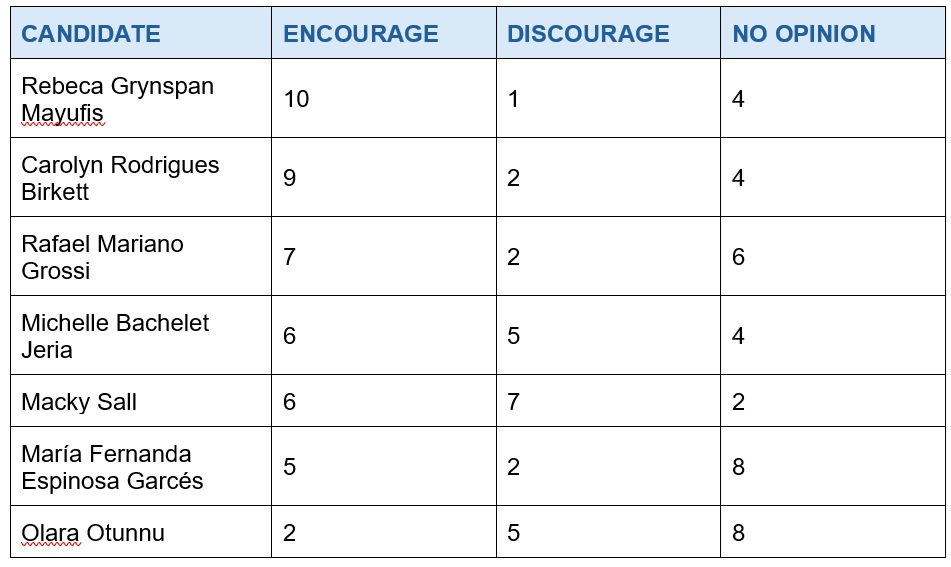
Results of the Second Security Council Straw Poll
Source: 1 for 8 Billion.
In the second straw poll, the “encouraged” votes accounted for 32.5 percent of the ballots, the “discouraged” votes for 35 percent, and the “no-opinion expressed” for 32.5 percent, an almost even split among the three categories.
The Council’s decision to recommend to the General Assembly a candidate for appointment as Secretary-General is deemed a matter of substance, which under Article 27 (3) of the UN Charter requires “an affirmative vote of nine members including the concurring votes of the permanent members”. In the second straw poll, none of the candidates garnered nine “encouraged” votes, the minimum number needed if this were a formal vote. (Grynspan and Rodrigues Birkett had respectively registered ten and nine votes during the first straw poll.)
A comparison with the 2016 process suggests that Council members have not coalesced around a candidate as they had at a similar stage a decade ago. In 2016, António Guterres rapidly emerged as the clear front-runner and retained a solid position throughout the straw polling process, never garnering less than 11 “encouraged” votes.
The rate of “discouraged” votes increased between the first and second straw polls in both the 2016 and the current process—from approximately 30.5 percent to 44 percent in 2016, and from approximately 23 percent to 35 percent in 2026. However, in 2016 the “no-opinion expressed” rate fell from approximately 21.7 percent to 17 percent between the first and second straw poll, while in 2026 the no-opinion rate declined only marginally, from approximately 34.3 percent to 32.5 percent. This means that nearly one-third of all ballots cast in the second straw poll still reflected an unwillingness to either support or reject a candidate, leaving the race considerably more open than it was during the early stages of the selection process that resulted in Guterres’ appointment.
The pace of the Council’s decision-making and the amount of time available for the next Secretary-General to prepare for office are emerging as key issues. The final Security Council straw poll during both the 2016 process and the process that led to Ban Ki-moon’s appointment as Secretary-General in 2006 were held in early October.
The importance of a timely decision was acknowledged at the outset of the current process. The joint letter by the Presidents of the General Assembly and the Security Council, which launched the process in November 2025, stated that the Council planned “to make its recommendation to the General Assembly in a timely manner”, so that the General Assembly’s appointment would allow “the newly appointed Secretary-General sufficient time to prepare for the job”.
The issue of the Council’s timely recommendation recently resurfaced in a 4 September letter from the outgoing President of the General Assembly, Annalena Baerbock, who finished her term on 8 September. The letter takes stock of the modalities of the Secretary-General selection process and offers recommendations for its remaining stages, as well as for future reforms. Citing the November 2025 joint letter’s reference to the Council providing its recommendation “in a timely manner”, Baerbock stressed that “the Security Council should be held accountable” for implementing that commitment. More broadly, Baerbock’s letter stressed the importance of predictability, inclusivity, and transparency, and of the role of the General Assembly in the process.
Tomorrow’s straw poll will be important in determining the next steps of the process. If the number of no-opinion ballots goes down and one or two candidates emerge with stronger levels of support while reducing their “discouraged” votes, this could signify that Council members are beginning to coalesce more clearly around a potential leading contender or contenders. However, if the informal vote again produces a fragmented result, speculation about broadening or reopening the field could intensify.
Tomorrow’s informal vote comes just ahead of the UN General Assembly’s High-Level Week, when heads of state or government, foreign ministers, and senior diplomats will converge at UN Headquarters in New York. This might provide an important opportunity for informal discussions on the Secretary-General selection process. A fourth straw poll could follow shortly after High-Level Week, which will conclude on 28 September, potentially offering the first indication of whether discussions held on the margins of the annual gathering have helped narrow the field or build momentum behind a candidate.
__________________________________________________________
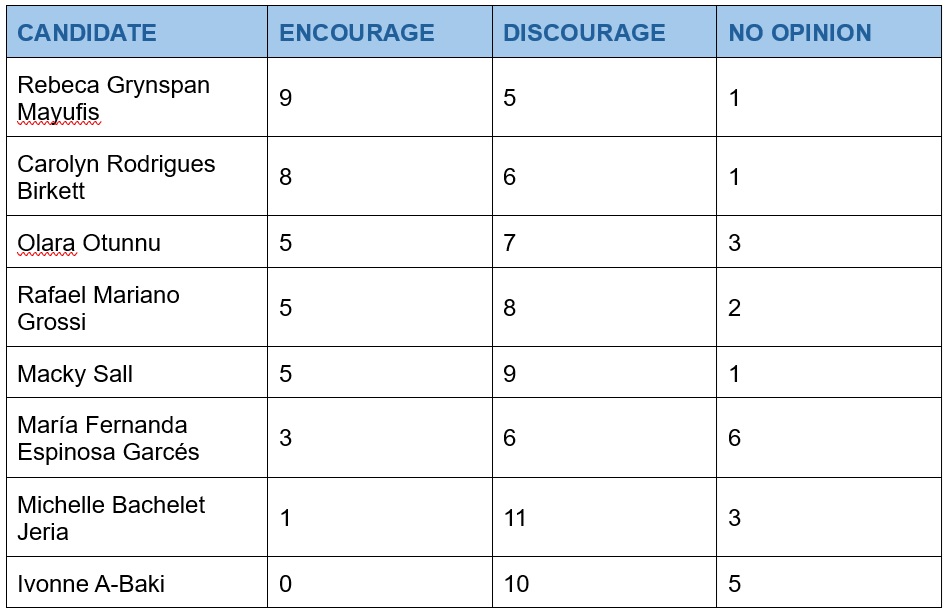
**Post-script: The results of the third Security Council straw poll are as follows:
Source: 1 for 8 Billion.