
Second Security Council Straw Poll on UN Secretary-General Candidates*
Tomorrow morning (21 August), Security Council members are expected to participate in the second straw poll to select a candidate to recommend to the General Assembly as the next UN Secretary-General. Article 97 of the UN Charter states that the “Secretary-General shall be appointed by the General Assembly upon the recommendation of the Security Council”. Straw polls are informal ballots used to determine the viability of Secretary-General candidates before the Council makes its formal recommendation through a resolution.
Like the first straw poll, which was held on 30 July, tomorrow’s straw poll is expected to take place in the consultations room. This is in accordance with the non-paper on modalities agreed by Council members in May. Today (20 August), Latvia and Russia were appointed as tellers.
At tomorrow’s straw poll, there will again be no difference between the ballots used by the five permanent members (P5) and the ten elected members (E10). Council members are expected to receive one ballot per candidate, containing the candidate’s name followed by three options: “encouraged”, “discouraged”, and “no opinion expressed”. No representatives of the Secretariat will be present, no official record of the results will be kept, and the presidency is expected to shred the ballots at the end of the straw poll. (For background, see our April 2026 research report titled “Power, Process and Participation: The Search for the Next Secretary-General”.)
One more candidate has been announced since the last straw poll, with the nomination of Ivonne A-Baki on 17 August. The eight current candidates, all of whom will appear on the ballots tomorrow, are:
- Ivonne A-Baki (Ecuador), who was nominated by Tonga on 17 August;
- Michelle Bachelet Jeria (Chile), who was nominated by Brazil, Chile, and Mexico on 2 February, with Chile withdrawing its nomination on 24 March;
- María Fernanda Espinosa Garcés (Ecuador), who was nominated by Antigua and Barbuda on 11 May;
- Rafael Mariano Grossi (Argentina), who was nominated by Argentina on 26 November 2025;
- Rebeca Grynspan Mayufis (Costa Rica), who was nominated by Costa Rica on 3 March;
- Olara Otunnu (Uganda), who was nominated by Uganda on 24 July;
- Carolyn Rodrigues Birkett (Guyana), who was nominated by Guyana on 15 June; and
- Macky Sall (Senegal), who was nominated by Burundi on 2 March.
All current candidates have now held webcast interactive dialogues with the General Assembly and informal dialogues with the Council. However, one candidate, Otunnu, participated in the dialogues only after having appeared on the ballot in the first straw poll. He held his dialogue with the General Assembly yesterday (19 August) and with the Council today (20 August).
While the dialogues are currently not mandatory steps for a candidate to be considered in a straw poll, the inclusion of Otunnu in the first straw poll without having first participated in the dialogues was controversial. All the candidates who had been nominated up to that point, as well as all candidates who participated in the 2016 selection and appointment process, had participated in dialogues with the Assembly, followed by an informal meeting with the Council, ahead of being included in the straw polls. That this precedent was not followed raised concerns that candidates could face unequal conditions and that potential new nominees could be encouraged not to meaningfully engage with the General Assembly in the future. (For more information, see our 29 July What’s in Blue story.)
The most recent candidate, A-Baki, participated in her dialogues with the General Assembly and the Security Council today.
Tomorrow, Ambassador Christina Markus Lassen (Denmark), on behalf of this month’s Danish Council presidency, is expected to simply announce to the press that the straw poll has taken place without giving any information about the results. During the negotiations on the modalities non-paper, which has not been made public, consensus could not be achieved among Council members on publicly releasing the results of the straw polls. While members such as Denmark, Greece, and Latvia called for releasing the results, several members, including among the E10, opposed this option, arguing that the results should be kept confidential. As the modalities are agreed by consensus, Council members ultimately decided not to announce the results publicly.
Accordingly, the results of the first straw poll were not officially announced by the President of the Security Council. They were nonetheless quickly leaked and published online.
Results of the first Security Council straw poll
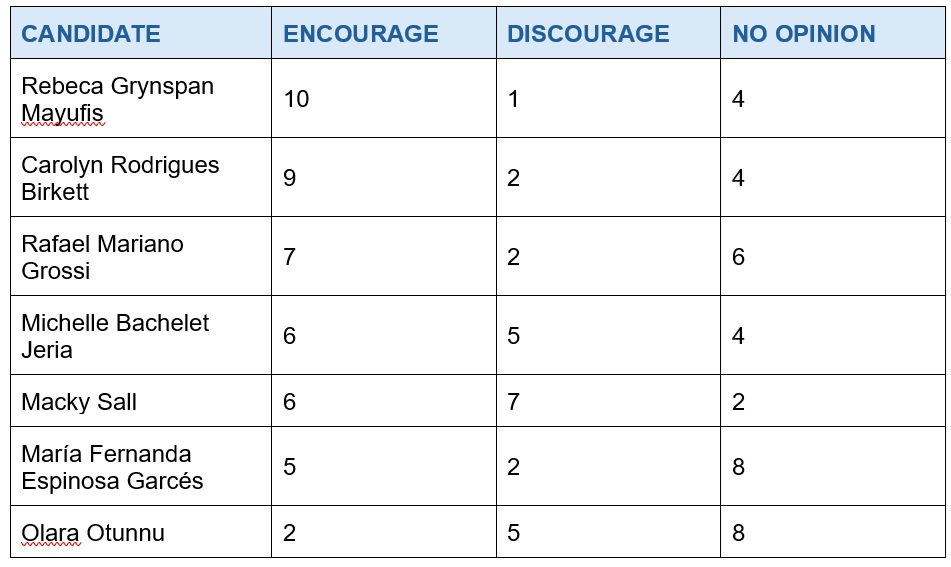
Source: 1 for 8 Billion.
A comparison with the first straw poll in 2016 indicates that the number of “no opinion expressed” ballots cast in the first straw poll in 2026 was relatively high. Approximately 34 percent of all ballots cast during that poll were no-opinion votes, compared to about 21 percent in the first straw poll in 2016. Combined with the possibility that additional candidates may still emerge, these figures suggest that the selection process remains relatively open. Significant shifts in the number of “encouraged” or “discouraged” votes at tomorrow’s straw poll are likely to prompt questions about the viability of some candidates. (For more analysis of the first straw poll results, listen to the 19 August episode of our Interactive Dialogues podcast.)
The selection and appointment process for the next Secretary-General was among the main topics discussed at yesterday’s annual open debate on the working methods of the Security Council. Many UN member states that are not on the Security Council raised the issue of transparency in connection with the public release of the straw poll results. Liechtenstein, for instance, argued that the decision not to release the results of the straw polls falls short of the principles of transparency, accountability, and inclusivity that should guide the process. Similarly, Belgium, on behalf of the Benelux countries (Belgium, the Netherlands, and Luxembourg), argued that communicating the results would enhance the Council’s transparency. Singapore noted that the current situation, whereby results become known through leaks, “is not good for the credibility of the process, nor the credibility of the Council”. Estonia, the Philippines, and South Africa called on the Council to consider publicly announcing the results. Romania called for a “practical and consensual solution to the dissemination of the results” to the wider UN membership. Several speakers more generally called for enhancing communication between the Council and the General Assembly.
The E10, which delivered a joint statement, noted the value of reflecting on lessons learned once the selection process is completed in order to improve the Council’s working methods in future selection processes. Australia made a similar recommendation.
Many participants also addressed the respective roles of the Council and the Assembly in the context of the selection and appointment process. Russia said that Article 97 of the UN Charter establishes “a strict distribution of roles between the Security Council and the General Assembly”. By contrast, Egypt and India called for strengthening the role of the General Assembly in this process. The US stressed that the Council is allowed to consider candidates even if they do not participate in the dialogues with the General Assembly and criticised the President of the General Assembly for, among other things, calling on the Council not to consider candidates until they have held a dialogue with the Assembly.
Questions regarding the respective roles of the Council and the Assembly in this process were also reflected in proposals from Thailand and the Accountability, Coherence and Transparency (ACT) Group—which comprises 27 UN member states—for the Council to recommend multiple candidates for the General Assembly’s consideration. South Africa similarly suggested that, should the Council be unable to make a single recommendation, “it should consider recommending more than one candidate for the General Assembly to decide on”. The ACT Group also encouraged the Council to conclude its consideration of candidacies and make its recommendation no later than 1 October.
____________________________________________________________________________________
**Post-script: The results of the second Security Council straw poll are as follows:
Source: 1 for 8 Billion