UN-AU Cooperation: Reflections on the Past Decade and the Way Forward
Introduction
October will be an important month for United Nations (UN)-African Union (AU) cooperation. UN Security Council members will hold their annual briefing on this topic, based on the Secretary-General’s report on strengthening the partnership between the UN and the AU on issues of peace and security in Africa, including the work of the UN Office to the AU (UNOAU). [1] This will be Secretary-General António Guterres’ last report on the topic before he leaves office at the end of December. (For more, see our brief on UN-AU Cooperation.)
Security Council members will also receive an update on the implementation of resolution 2719 of 21 December 2023, on the financing of AU-led Peace Support Operations (AUPSOs). This is in line with paragraph 17 of the resolution which expresses the Council’s intention to review its implementation three years after its adoption.
In October, Security Council members will hold their annual consultations with the AU Peace and Security Council (AUPSC) in New York. During the meeting, they are set to exchange views with their AUPSC counterparts on a range of country- and region-specific situations in Africa. They will also discuss a select number of thematic topics during their joint informal seminar with the AUPSC preceding the annual consultations, which this year will be held in a retreat format at Greentree. While in New York, AUPSC members are also expected to hold their annual meeting with the UN Peacebuilding Commission, which was initiated in 2016 and has become a regular feature of UN-AU partnership.
This month’s In Hindsight will assess the progress and challenges of UN-AU cooperation in a fractured multilateral landscape. It will highlight ongoing reform efforts that could help strengthen the partnership and adapt it to the evolving times. It will also consider the implications of the selection process of the next Secretary-General for the future of the UN-AU partnership.
Cooperation Frameworks and Mechanisms
Over the past decade, Guterres’ tenure has seen significant institutionalisation of the UN-AU partnership. During his first address to the 28th AU summit in Addis Ababa in January 2017, Guterres underscored the significance of the partnership and expressed his commitment to work with the AU to advance peace, security, and development in the continent.[2]
Chart: Institutionalisation of the UN-AU Partnership
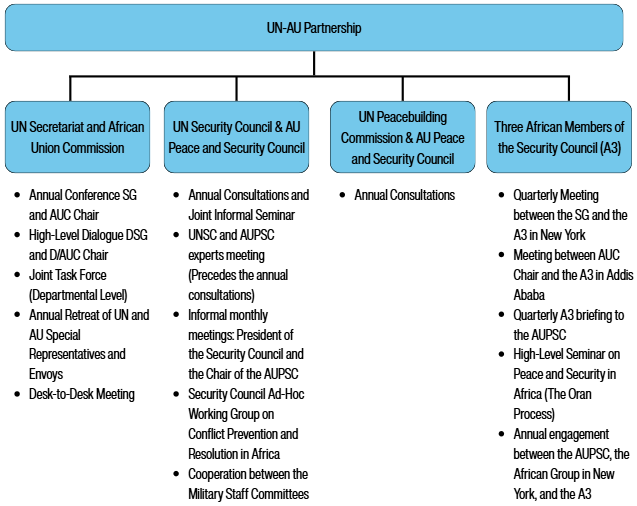
Under his leadership, the two organisations signed three overarching partnership frameworks aligned with the three pillars of UN-AU cooperation: peace and security, sustainable development, and human rights. Guterres also initiated the annual conference between the leadership of the two organisations to review the partnership, complementing existing mechanisms for desk-to-desk and departmental level engagements through the Joint Task Force meetings initiated in 2008 and 2010, respectively. This is the most extensive and institutionalised cooperation that the UN has developed with any other regional or sub-regional organisation in the spirit of Chapter VIII of the UN Charter.[3]
In recent years, Guterres has started meeting with the three African members (A3) quarterly in recognition of their growing profile within the Security Council, particularly in advancing African priorities. His AU counterpart, Ali Mahmoud Youssouf, also recently initiated a similar engagement with diplomats in Addis Ababa from the Council’s A3.[4]
For their part, Security Council members have maintained their regular consultations with their AUPSC counterparts. The Security Council Ad-Hoc Working Group on Conflict Prevention and Resolution in Africa (AWG) is the subsidiary body in charge of organising these annual consultations in coordination with the AU side. The AWG’s role is supported by the joint work of experts from the two Councils who meet in advance of the annual consultations to, among other things, negotiate the outcome document. Over the past decade, informal monthly meetings between the president of the Security Council and the chair of the AUPSC to align the programmes of work of the two Councils have been a regular feature of their engagements. According to the Secretary-General’s report, ten such meetings have been held over the past year.
Mediation and Conflict Resolution
Early in his tenure, Guterres embraced “Silencing the Guns in Africa”,[5] the AU’s flagship initiative aimed at eliminating conflicts and crises in the continent by 2020—a target that was subsequently extended to 2030. The initiative was later boosted by the Security Council’s formal endorsement through the adoption of resolution 2457 on 27 February 2019, spearheaded by the A3. Guterres called for a “surge of diplomacy for peace” as a central theme of his broader peacemaking efforts. In Africa, he sought to enhance collaboration with the AU and its regional mechanisms in addressing conflicts and crises.
These efforts, however, faced significant setbacks as the continent’s peace and security situation deteriorated, making the lofty goal of “silencing the guns in Africa” increasingly appear a distant prospect. At the same time, growing geopolitical tensions eroded the broad consensus that had once underpinned regional and multilateral approaches to conflict prevention and resolution through the AU, its regional mechanisms, and the UN.
Although Guterres spoke of a “wind of hope” blowing across the Horn of Africa, following the signing of a peace agreement between Ethiopia and Eritrea and the normalisation of relations between Djibouti and Eritrea in 2018, that optimism was subsequently undermined by the outbreak of war in the Tigray region of Ethiopia in November 2020 and its devastating consequences. After a cessation of hostilities following the signing of the November 2022 Pretoria Agreement, renewed tensions now appear to threaten another conflict and draw neighbouring countries into a wider regional war. Sudan likewise offered grounds for hope following the 2019 revolution that ended President Omar al-Bashir’s thirty-year rule, but this proved short-lived as the country descended into a devastating civil war. In South Sudan, the 2018 Revitalized Peace Agreement has also come under increasing strain, with the country once again teetering on the brink of another cycle of conflict and violence.
Furthermore, peace in the eastern Democratic Republic of the Congo (DRC) has remained elusive. The situation has worsened in recent years as fighting between the Congolese armed forces and the Mouvement du 23 Mars (M23) rebel group has intensified, exacerbating regional tensions in the Great Lakes. In West Africa and the Sahel, the threat of terrorism has not only surged in intensity but also expanded geographically, threatening to engulf coastal states. Libya, meanwhile, is still mired in a political crisis, with rival factions unable to overcome their differences and pave the way for national elections. The recent agreement reached by Libyan political stakeholders under the UN auspices to work toward holding the elections within a period not exceeding 24 months brings a glimmer of hope to this situation.[6] However, whether it will finally succeed in breaking the political impasse remains to be seen.
While the UN and the AU have sought to work together and coordinate their efforts across these different conflict and crisis situations, they have found themselves increasingly sidelined as other actors, including Qatar and the US, assume a leading role in mediation efforts.
Peacekeeping and Peace Support Operations
From the outset of his tenure, Guterres repeatedly called for a new generation of AUPSOs with guaranteed funding, including through UN assessed contributions, to address Africa’s peace and security challenges. While he faced criticisms for shifting towards militarised approaches, he continued to express strong support for regional and sub-regional organisations undertaking peace enforcement operations, particularly in situations where there is effectively no peace to keep.[7]
The need for adequate, predictable, and sustainable funding for AUPSOs has been the subject of UN-AU discussions for more than a decade. Guterres began his tenure following the submission of the report of the High-Level Independent Panel on Peace Operations, which made specific recommendations on providing financial support to AUPSOs through UN assessed contributions, to be authorised on a case-by-case basis. (For background, see our April 2023 research report The Financing of AU Peace Support Operations: Prospects for Progress in the Security Council?)
Since 2017, Guterres pushed for the Group of Five for the Sahel Joint Force (FC-G5S) in West Africa and the Sahel, a regional counter-terrorism force comprised of Burkina Faso, Chad, Mali, Mauritania, and Niger, to receive funding through UN assessed contributions. Nonetheless, the Security Council authorised only limited operational and logistical support through the UN Multidimensional Integrated Stabilization Mission in Mali (MINUSMA) when the joint force conducted operations on Malian territory.[8] In December 2023, FC-G5S was dissolved following the formation of a new alliance by the military juntas of Burkina Faso, Mali, and Niger in September. MINUSMA’s mandate was also terminated in June of that year after Mali withdrew its consent, leading to the mission’s abrupt departure in December.
Despite this setback, Guterres presented a set of concrete proposals to the Security Council on the financing of AUPSOs, including his May 2023 report,[9] which ultimately paved the way for the adoption of resolution 2719 on the financing of AUPSOs. Subsequently, Guterres, in close consultations with the AU, laid out options for applying the 2719 framework to the AU Support and Stabilization Mission in Somalia (AUSSOM), which is facing serious funding constraints. However, these efforts ultimately failed to materialise due to opposition from the US, which was wary of using AUSSOM as a first test case for applying the 2719 framework and insisted on the fulfilment of several conditions, including a “one mission, one budget” model to provide support to AUPSOs.[10]
Notwithstanding the lack of consensus on this particular case, the UN and the AU have continued to work jointly in laying the groundwork for the resolution’s operationalisation so that, when the opportunity arises to apply it in a specific situation, the necessary institutional, financial, and operational arrangements will already be in place. In this regard, they have already developed joint modalities for planning, decision-making, and reporting processes to unpack paragraphs 2 and 3 of the resolution. They have also mapped out mission support modalities on logistics, operational readiness, and support structures required to sustain AUPSOs to be authorised under resolution 2719.
Chart: Operationalisation of Resolution 2719
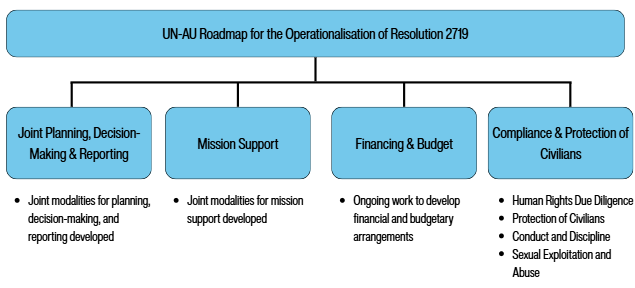
Additionally, there is ongoing work to develop other modalities for compliance and protection of civilians, as well as financing and budgeting arrangements, to ensure the necessary institutional and operational readiness. The Secretary-General’s latest report notes “preparations for a scenario-based tabletop exercise to test and validate the joint modalities and for the development of guidance on joint strategic assessments”.
Institutional Reform
Both the UN and the AU recognise the need to reform and adapt themselves to the evolving geopolitical and security landscape. In March 2025, Guterres launched the UN80 Initiative, a broad reform effort aimed at making the UN more efficient, agile, and fit for purpose. He also initiated a comprehensive review of the future of all forms of UN peace operations, as mandated by the Pact for the Future adopted at the 2024 Summit of the Future. The review, which was submitted to both the Security Council and the General Assembly in August, offered recommendations on ways to adapt UN peace operations to current and future threats and challenges.[11]
The AU, for its part, is also undergoing institutional reform to strengthen its governance structures, streamline decision-making processes, and enhance the impact of its various organs. It is reviewing the African Peace and Security Architecture (APSA), its overarching framework of institutions and norms for conflict prevention, management, and resolution in the continent. Additionally, it is reviewing AUPSOs, including the African Standby Force, one of the key components of APSA. AU heads of government met in an extraordinary session in Luanda, Angola, in August to discuss the APSA review in the context of enhancing conflict prevention and resolution efforts in Africa.
These parallel reform processes are not without challenges, and their success will depend on the full buy-in of member states. At the same time, they also present an opportunity to strengthen complementarity between the two organisations and adapt their partnership to a rapidly changing multilateral and security landscape. At the informal seminar preceding the annual joint consultations between Security Council and AUPSC members in New York this month, the members of the two Councils are expected to exchange views on the respective reviews of UN peace operations and AUPSOs.
The next UN Secretary-General
The role of the next UN Secretary-General will be important in advancing the UN-AU partnership over the coming period in close coordination and collaboration with their AU counterpart. Several candidates vying for the position have actively engaged with the African group in New York to hear African views and perspectives. Some travelled to Addis Ababa to hold meetings with the leadership of the AU Commission. Others went to the capitals of the Council’s A3 members. In August, several candidates travelled to Luanda to engage with African leaders and participate in the discussions on strengthening conflict prevention and resolution in the continent.
Whoever is ultimately appointed will be expected to bring a fresh perspective to the UN-AU partnership, informed by the progress and difficulties of the past decade and the need to meet current and future peace and security challenges in Africa. Upon taking office in January, they will face the immediate responsibility of helping to find solutions to the continent’s protracted and complex conflicts.
Expectations are especially high for the next Secretary-General to raise the UN’s profile and visibility in peacemaking efforts by effectively leveraging the UN’s good offices and convening power. This may require greater political engagement on the ground, including reinforcing the work of UN peace operations and Special Political Missions (SPMs), and coordinating more closely with the AU and its regional mechanisms.
The next Secretary-General is also expected to implement the recommendations emerging from the review on the future of all forms of UN peace operations. The review underscores the need for “global-regional partnerships for networked peace operations” and calls for the Security Council to be prepared to act proactively in considering and authorising support for AUPSOs under resolution 2719, on a case-by-case basis, drawing on contexts identified jointly by the UN and the AU. It further notes that such decisions should not only be guided by the primacy of politics, ensuring that any application of the resolution advances political solutions, but also on the comparative advantages of the two organisations.
Concluding Observations
While the UN-AU partnership has certainly come a long way, it needs to adapt itself to meet the needs and expectations of the time. The various mechanisms established over the years have provided the partnership with solid institutional foundations. However, it now faces significant challenges, as both organisations grapple with questions of relevance and effectiveness.
A major priority for the two organisations over the coming period should be to make greater use of their existing mechanisms to reinvigorate their peacemaking and conflict management efforts rather than create new structures. Realistically, they cannot be expected to work miracles in resolving the many intractable conflicts on the continent, given the multiple factors at play. However, the leadership of both organisations should maintain a visible presence on the ground, in addition to their Special Envoys and Representatives, working jointly to respond to conflicts and crises across the continent and coordinate their efforts.
One possible initiative could be for the two organisations to undertake joint high-level visits to some of the continent’s most pressing conflict situations. Such visits could provide a visible demonstration of their shared commitment to addressing Africa’s peace and security challenges and help change public perception of them. They could also revive joint visits at the level of Under-Secretaries-General and Commissioners which took place in the past but have not continued. For their part, the Security Council and the AUPSC could consider implementing joint field visits which were agreed in principle but never materialised.
With UN peacekeeping operations facing a significant liquidity crisis, the prospects for operationalising resolution 2719 over the coming period may appear slim. At the same time, however, the UN Support Office model envisaged in the resolution—whereby a UN presence provides logistical and operational support for robust military operations conducted by other actors—may continue to be of interest. This could include, but not be limited to, enforcement or counter-terrorism settings, as demonstrated by the authorisation of the Gang Suppression Force in Haiti. There therefore remains a possibility of applying the resolution provided that sufficient progress is made in meeting the conditions set out in the resolution and that a suitable test case commands the necessary consensus within the Security Council. The next Secretary-General will have an important role to play in creating the necessary conditions for operationalising the resolution, working closely with the AU’s leadership. Council members could take advantage of the resolution’s upcoming review to take stock of progress and chart a way forward. A possible option would be for the A3 to propose a draft presidential statement for adoption during Liberia’s Security Council presidency in December.
The collective efforts of the two organisations could play a critical role in preventing post-conflict countries from relapsing into another cycle of conflict and violence and ensuring that other potential crisis situations do not escalate into full blown wars. Their ability to do so will depend on enhanced cooperation in early warning and response, underpinned by shared analysis and a common understanding of the dynamics and risks in these situations. Where the AU and its regional mechanisms are in a better position to respond quickly and effectively, the UN should provide the necessary support. However, this partnership should not become an excuse for inaction where the AU and its regional mechanisms are unable to respond effectively. In such circumstances, the UN Security Council in particular should be prepared to act, consistent with its primary responsibility for the maintenance of international peace and security.
Most importantly, the two organisations should go beyond visibility and take the lead in proposing concrete measures to de-escalate ongoing conflicts and facilitate cessations of hostilities, thereby creating space for the peaceful settlement of disputes. This requires that they draw the right lessons from past efforts, including why they have fallen short of delivering the desired results in particular cases. They should seize the opportunity presented by the institutional reform processes to address prevailing gaps in their peace and security cooperation and work towards strengthening existing tools. Neither organisation can afford to miss this chance to remain relevant and regain the trust and confidence of member states and, indeed, the wider public, in addressing the multitude of dire security crises facing Africa.
[1] UN Secretary-General, Strengthening the partnership between the UN and the AU on issues of peace and security in Africa, including the work of the UNOAU, S/2026/682 (17 August 2026), https://docs.un.org/en/S/2026/682.
[2] António Guterres, “Secretary-General’s Remarks to the African Union Summit”, United Nations, 30 January 2017, https://www.un.org/sg/en/content/sg/statements/2017-01-30/secretary-generals-remarks-the-african-union-summit-delivered.
[3] Chapter VIII of the UN Charter focuses on how regional organisations cooperate with the UN in the maintenance of international peace and security.
[4] AU Commission, “AUC Chairperson Hosted the Quarterly Working Luncheon with the Permanent Members of the Ambassadors of UN Security Council (P5) & the A3 Accredited to the AU”, 11 August 2026, https://au.int/en/pressreleases/20260811/auc-chairperson-hosted-quarterly-working-luncheon-unsc-p5-and-a3.
[5] AU Master Road Map of Practical Steps to Silencing the Guns in Africa, African Union, 31 March 2020, https://au.int/en/documents/20200331/au-master-road-map-practical-steps-silencing-guns-africa.
[6] UN Support Mission in Libya (UNSMIL), “UNSMIL Welcomes Agreement on Next Steps towards National Elections”, 30 August 2026, https://unsmil.unmissions.org/en/news/unsmil-welcomes-agreement-on-next-steps-towards-national-elections.
[7] “Put Peacemaking First as UN Missions Face Growing Threats, Secretary-General Urges Security Council”, United Nations, 18 September 2026, https://press.un.org/en/2026/sc16457.doc.htm.
[8] UN Security Council, Resolution 2391 (2017), S/RES/2391(2017) (8 December 2017), https://docs.un.org/en/S/RES/2391(2017).
[9] UN Secretary-General, Implementation of Security Council resolutions 2320 (2016) and 2378 (2017) and considerations related to the financing of African Union peace support operations mandated by the Security Council, S/2023/303 (1 May 2023), https://documents.un.org/doc/undoc/gen/n23/110/15/pdf/n2311015.pdf.
[10] Ambassador Dorothy Shea, “Explanation of Vote Following the Adoption of a UN Security Council Resolution Renewing the Mandate of AUSSOM”, US Mission to the UN, 27 December 2024, https://usun.usmission.gov/explanation-of-vote-following-the-adoption-of-a-un-security-council-resolution-renewing-the-mandate-of-aussom/.
[11] UN Secretary-General, Review on the future of all forms of UN peace operations, A/80/798-S/2026/600 (22 July 2026), https://docs.un.org/en/A/80/798.

